
In the early days in egalitarian societies, science, philosophy, and knowledge were fair game to all. There was no elitism in the process of acquiring knowledge.
With the advent of newer ways of scientific dissemination and increasing technological sophistication, science became niche. Pursuing research became a privilege. One now needs affluence for education and an incredible amount of patience. While the latter is a matter of choice, the former is a variable skewed towards aristocracy.
However, free thinking cannot be colonised. When free thinking is coupled with tenacious curiosity, it can lead to scientifically valuable contributions. I was able to prove this from my own experience. Nearly seven years ago, I was introduced to a scientific problem that was complex yet solvable for a novice student of physics like me.
I did not have any funding for this but just an old laptop and a basic knowledge of calculus and Python. I used to sit in isolation for hours just thinking, coming up with new ways to understand the problem, reading previous works, starting from basics and learning the fundamentals to build a strong foundation for my solution.
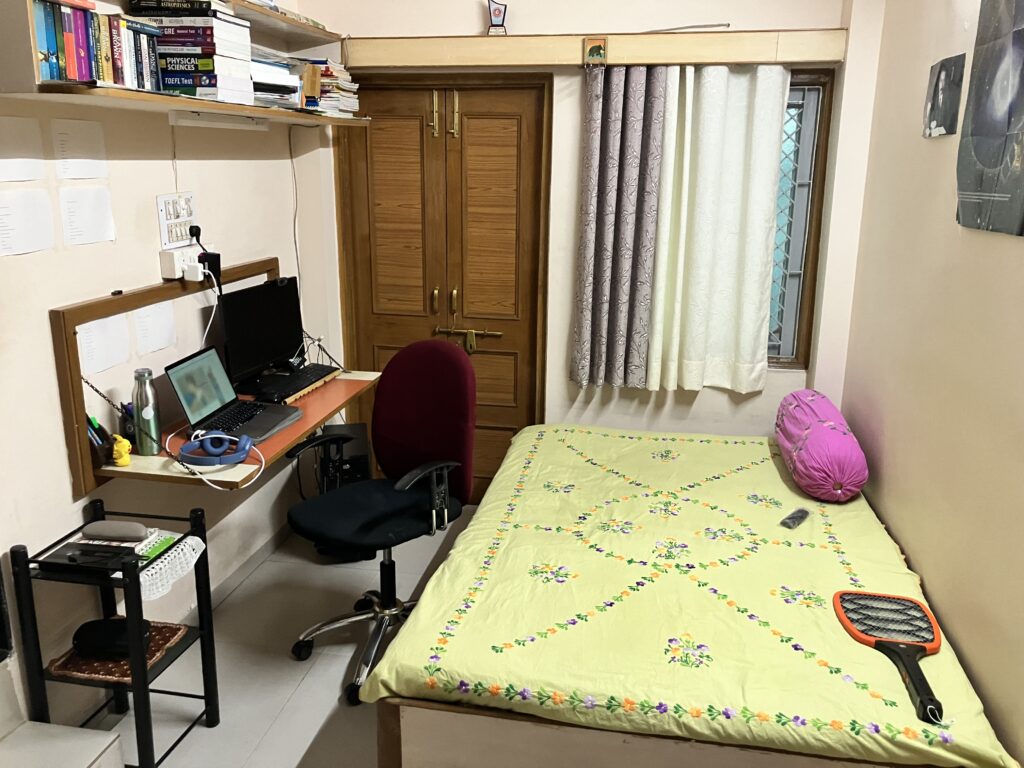
My room was a bit like the “cupboard under the stairs”. But, it was a special place for me. It was here I could be alone with my thoughts, with the intricate problem I was tackling. I remember not realising things around me because I was lost so deep in thought. I was also scribbling a lot of equations, coding, and failing. However, I kept learning and striving for making my solution more robust.
After 9 months of hard work, I thought I had solved the problem. I submitted an article explaining the work to one of the top astronomy journals, and to my surprise, it got accepted. I did not have an affiliation so I published as an independent researcher.
I knew my mathematics made sense but it was still a surreal feeling to think that I was right. I was so critical of myself that I was never complacent with the work. The acceptance from the journal made me feel satisfied that I solved the problem.
Alas, there was a small mistake in my calculations. It was so subtle that even some of my smartest colleagues missed it when I told them about my work. In fact, many similar attempts by professional astronomers did the same mistake. When I realised the mistake, with the help of my brilliant colleague, I had to fix it. And within 2 weeks of mathematically tormenting days, I did fix it. But it was too late since the journal decided to retract the paper. All my hard work was left pointless with a stain of a retraction on my career.
But, I started writing a new paper with my colleague. I faced 8 rejections over the next 5 years from various journals. Every rejection taught me something new about the process. It gave me the feedback that I did not have the privilege to acquire, due to lack of resources and institutional funding crucial for scientific research and publishing.
I finally had such strong understanding of the topic, that I could explain it to someone in my sleep. To add some more drama to this story, a researcher who wrote her PhD thesis on this problem managed to submit a paper on this work before me. But, she also made a mistake akin to mine! Due to my tenacity and experience on the equations involved, I identified the mistake and, taking into account the feedback from all the rejections I faced throughout the 5 years, I wrote another paper as a last-ditch attempt. I was fortunate to have my supervisor help me with the process of submission and a more scientifically polished way of writing. And it got accepted after a few revisions in one of the elite astrophysics journals. Here is the link for those a bit more curious —
(https://iopscience.iop.org/article/10.3847/1538-4357/ae29ea).
I had become so numb through the entire process that I felt more relieved than happy. However, I had managed to take down a thesis of an established researcher, who was an expert in that field, knowing that my current research was in a different field of astrophysics after these 5 years of career progression, which was radically different from this old problem. It was a moment of pride.
The process taught me that curiosity, tenacity, and a willingness to learn from failures can help one outperform any aristocratic system. In other words, science and knowledge are indeed emancipated. One has to be obsessively driven to grab the fruits of it.

Leave a Reply