
It is an extremely rare accomplishment to manifest one’s full potential, which is called self-actualisation in psychological parlance. What is even rarer is to transcend one’s limits. Abraham Maslow, a renowned psychologist, created a pyramid of needs and accomplishments, which hosted self-actualization at the summit, marking the epitome of psychological robustness. However, there is an old adage that offers some humility: “The summit of a mountain is the base of another.”
The other pyramid or mountain that sits on top of Maslow’s pyramid might be thought of as a route to self-transcendence. This is where ambition turns into vision. Survival instincts turn into altruism. Envy and jealousy turn into empathy and love for humanity as a whole. Examples of people who seem to have reached this stage include M.K. Gandhi, Anne Frank, and Albert Einstein.
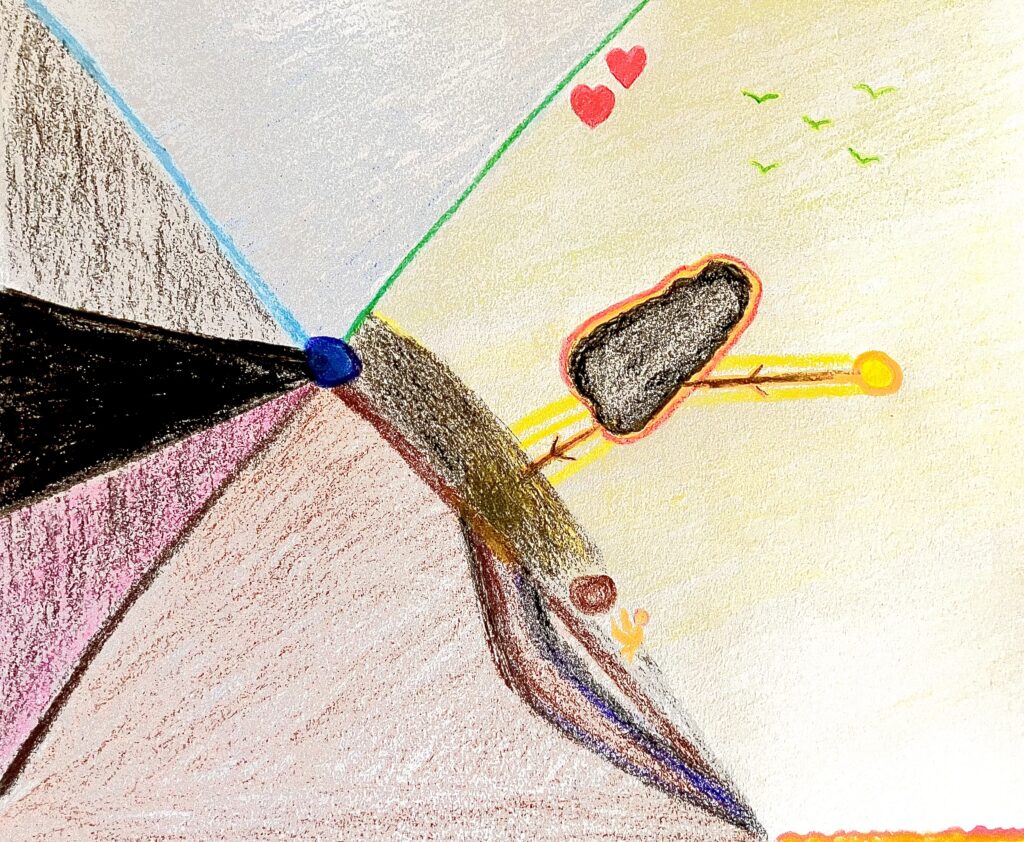
These historical figures embraced the way the world worked and strived for equality and pacifism. However, the journey to the summit of Maslow’s mountain is extremely hard. It is, in principle, possible for everyone, but it takes enormous pain and torment to accomplish. One has to face and make peace with one’s own shadow. The shadow, as conceptualized by Carl Jung, is the hidden unconscious part of the human psyche, evading conscious thoughts. An act of total disintegration often acts as a catalyst and can bring someone face to face with their own shadow. Dąbrowskian theory of positive disintegration helps one understand how every mental breakdown is a chance for growth. It is this growth that slowly, excruciatingly, yet importantly takes one to self-actualisation.
The journey from self-actualisation to self-transcendence is even tougher. One can then introspect and ask, “You know yourself now, do you know your significance in this world?” One eventually, through their curiosity, discovers that life is a precious present and also a fleeting one. This inspires one to overcome the fear of death and emancipates him/her to spread knowledge, love, and contribute to other humans and all other life forms altruistically.
Albert Camus’s allegory of Sisyphus somehow springs up. The eternal process of radically accepting the process of integration and disintegration. Even more interestingly, Plato’s allegory of the cave can also be woven into this analogy. To be enlightened, one must also surpass the shadow of the dark clouds cast by his/her surroundings and culture. If one doesn’t know these limitations, he keeps falling in the cave instead of failing and restarting like Sisyphus.
I mentioned earlier that there is still a mountain to climb after achieving true self-knowledge. That mountain is finding and falling in love. In Jungian terms, this is the anima. I invoke another prominent symbol of the blade and chalice, which the Louvre famously hosts; the blade can be likened to the excruciating pyramidal journey and the chalice to the all-encompassing affection that complements the struggle and perseverance. More importantly, it provides a vessel where affection can be saved and grown. Together, they complete life’s picture, or rather, they integrate life’s puzzle.

Leave a Reply